Your dog collapses, your cat strains and cries in the litter tray, or your rabbit suddenly goes still, and your mind empties. The two questions that crowd out everything else are what do I do now and where do I go, especially after hours. This guide replaces the blank panic with a plan: what counts as a true emergency, what to do in the first ten minutes, and how emergency care works here in Subang Jaya.
- Any sudden event, breathing difficulty, collapse, poisoning, trauma, or a straining blocked cat, where minutes change the outcome.
- Your phone call and handling before arrival often matter as much as the treatment, especially for fragile exotics.
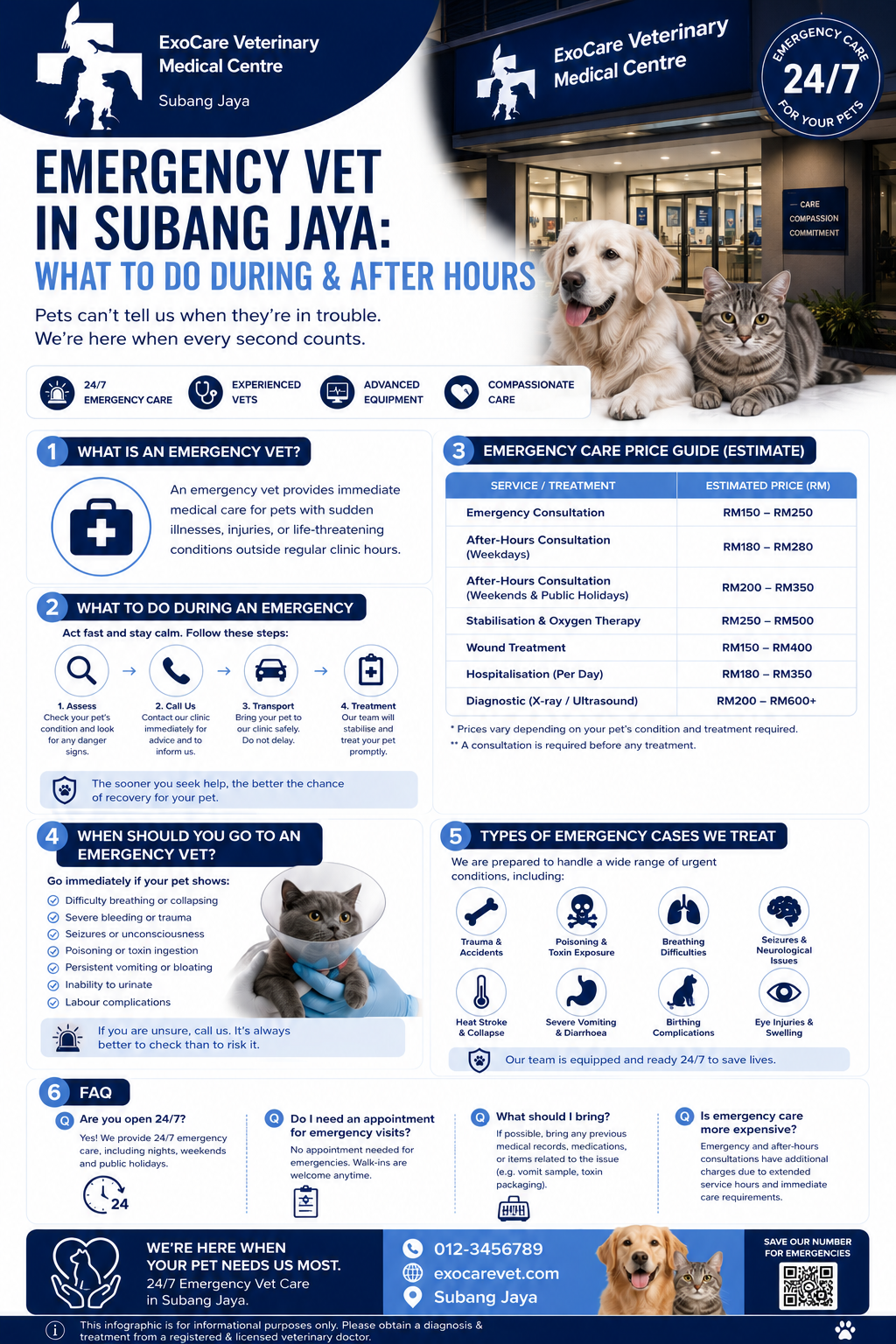
- Stay calm, phone ahead so we can prepare, stabilise safely, and bring records plus any suspected toxin packaging.
- Save our number, and a 24-hour clinic’s number, before you ever need them.
What actually counts as an emergency

Treat each of these as go-now:
-
Laboured or open-mouth breathing, or blue/grey gums: the body is failing to oxygenate; irreversible damage occurs within minutes. The most time-critical of all.
-
Collapse or inability to stand: internal bleeding, heart failure, poisoning, or a metabolic crash.
-
A distended, hard belly with unproductive retching (possible bloat in dogs): the stomach can twist and cut off its blood supply; rapidly fatal without surgery.
-
A male cat straining with little or no urine: a urinary blockage that can cause fatal kidney failure and cardiac arrest within 24–72 hours.
-
Seizures, especially repeated or lasting over five minutes: prolonged seizing overheats the body and injures the brain.
-
Suspected poisoning, uncontrolled bleeding, or major trauma: each can deteriorate fast; internal damage is often worse than it looks.
-
In exotics, sudden collapse, or a rabbit/rodent that stops eating and passing droppings: gut stasis or crisis, an emergency in prey species with minimal reserve.
Why exotic and small pets can’t wait
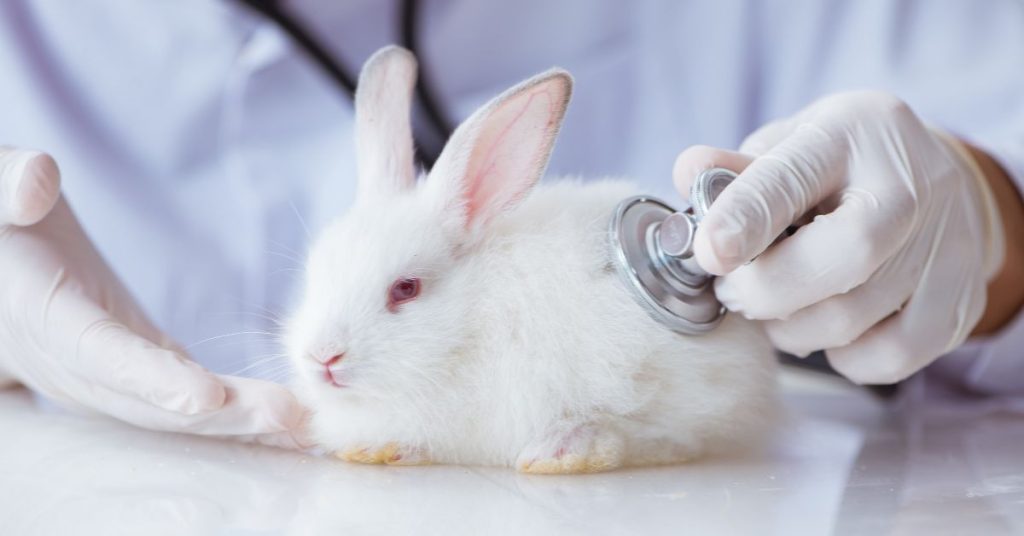
Exotic species are prey animals, wired to hide illness as long as possible. So a rabbit, bird, or rodent that “suddenly” looks sick has often been declining silently for days with almost nothing left in reserve. Add our heat, transport stress in a hot car can tip a fragile patient over the edge before it reaches the clinic, and the window for effective help is dramatically shorter than in a dog or cat. With an exotic, when in doubt, phone immediately.
The first ten minutes
-
Stay calm. Your anxiety travels down the lead and raises your pet’s stress, worsening breathing difficulty and cardiac demand. A calm handler helps keep the patient stable.
-
Phone the clinic first. Emergency care starts with your call. Describing what happened lets us prepare oxygen and equipment and give first-aid instructions specific to the situation.
-
Handle safely. Injured animals bite from pain and fear. A towel helps you restrain gently, but never muzzle a pet that is vomiting or struggling to breathe, it risks aspiration or suffocation.
-
Control bleeding. Firm, direct pressure with a clean cloth for at least three full minutes without lifting to check. If blood soaks through, add more on top rather than removing the first layer, which tears off any forming clot.
-
Keep warm and still. Confine to a small, secure carrier or box with air holes, and support the neck and back as one unit if you suspect a spinal injury.
Emergency myths that cost lives
| The myth | The clinical fact |
|---|---|
| “Induce vomiting for any poisoning.” | Wrong for corrosive and petroleum toxins and many species. Phone the vet before doing anything. |
| “A straining cat is just constipated.” | In male cats it’s often a life-threatening blockage; delay risks kidney failure within 24–72 hours. |
| “My rabbit will eat again by morning.” | Gut stasis (not eating, no droppings) is a genuine emergency in rabbits and rodents, not an overnight wait. |
| “Muzzle any injured pet for transport.” | Never muzzle a vomiting or breathing-distressed pet; it can cause aspiration or suffocation. |
Also Read: 8 Pet Emergency Symptoms You Cannot Ignore (Expert Review)
What phoning ahead does on our end
A heads-up lets us prepare oxygen, warming equipment, and the correct instruments before your pet arrives, a head start that matters most for exotics needing precise, weight-based stabilisation. Owners who bring prior records and the packaging of a suspected toxin let us reach the right treatment faster, because we aren’t reconstructing history or guessing at a poison. Our on-site diagnostics, digital X-ray, ultrasound, in-house cytology, and full bloodwork, mean the underlying problem is identified in the same visit.
A rabbit came in collapsed one afternoon. The owner had phoned from the car and kept him warm and still, so we were warming the table before they arrived and didn’t lose a minute. With a prey animal that fragile, those saved minutes are sometimes the whole story.
“In an emergency, the most valuable thing an owner can do isn’t heroics, it’s a calm phone call and safe transport. I’ve seen fragile exotic patients saved simply because the owner phoned ahead and kept them warm and still on the way in.” — Dr. Asma Farihah
When to call and what to bring

Call immediately during our hours for breathing difficulty or blue/grey gums, collapse, seizures, suspected poisoning, a straining or blocked cat, uncontrolled bleeding, a bloated abdomen, or an exotic that has stopped eating and passing droppings.
Our hours: Monday, and Wednesday to Sunday, 11:00am–7:00pm. Closed Tuesdays. Outside these hours, phone your nearest 24-hour facility while preparing to travel; save both numbers now.
Bring: previous records and recent bloodwork, your pet in a secure carrier, the packaging or a photo of any suspected toxin, and for exotics a fresh faecal sample.
Conclusion
Emergencies are frightening because they’re sudden and unfamiliar, but your response doesn’t have to be either. The core plan never changes, no matter what walks through the door: stay calm, phone ahead, stabilise safely, and transport securely in a covered carrier. Those four steps buy us the one thing that decides most emergencies, time, and for fragile exotic patients with almost no reserve, the first ten minutes and that first phone call can genuinely be the difference between a recovery and a loss.
If you spot an emergency during our hours, Monday and Wednesday to Sunday, 11:00am–7:00pm (closed Tuesdays), call us straight away so our team can prepare oxygen, warming, and the right equipment before you even arrive in Subang Jaya.
FAQ
Is ExoCare a 24-hour emergency vet in Subang Jaya?
Our hours are Monday, and Wednesday to Sunday, 11:00am–7:00pm; closed Tuesdays. During these hours, phone ahead so we can prepare. Outside them, contact your nearest 24-hour facility, which is why we recommend saving both numbers in advance.
Will I pay for diagnostics before treatment in an emergency?
Yes. Stabilisation and tests like X-rays or bloodwork are needed because we can’t safely treat what we haven’t identified. They turn guesswork into targeted treatment and are often the fastest route to the right intervention.
Should I treat my exotic pet at home first?
No. Because exotics hide illness and crash fast, watch-and-wait burns the narrow window when treatment still works, and many home remedies are unsafe for small species. Phone a vet experienced with exotics immediately.
References
- AVMA. First aid tips for pet owners. https://www.avma.org/resources-tools/pet-owners/emergencycare/first-aid-tips-pet-owners
- MSD Veterinary Manual. What to Do in a Dog or Cat Emergency. https://www.msdvetmanual.com/special-pet-topics/emergencies/what-to-do-in-a-dog-or-cat-emergency
- MSD Veterinary Manual. First Aid and Transport of Small Animals. https://www.msdvetmanual.com/emergency-medicine-and-critical-care/emergency-medicine-introduction/first-aid-and-transport-of-small-animals
- ASPCA. Emergency Care for Your Pet. https://www.aspca.org/pet-care/general-pet-care/emergency-care-your-pet
- Malaysian Veterinary Council (MVC). https://www.mvc.gov.my/
This article has been medically reviewed based on clinical protocols by:
Dr. Asma Farihah (MVC No. 3362).
Lead Veterinarian & Co-Founder, ExoCare Vet Medical Centre, Subang Jaya.
ExoCare is a referral veterinary medical center specializing in the medical, surgical, and critical care of small animals, exotic pets, avian species, reptiles, rodents, and amphibians in Malaysia.